Belfast: Queens Bridge Siphon’s Phase II relining
Challenge
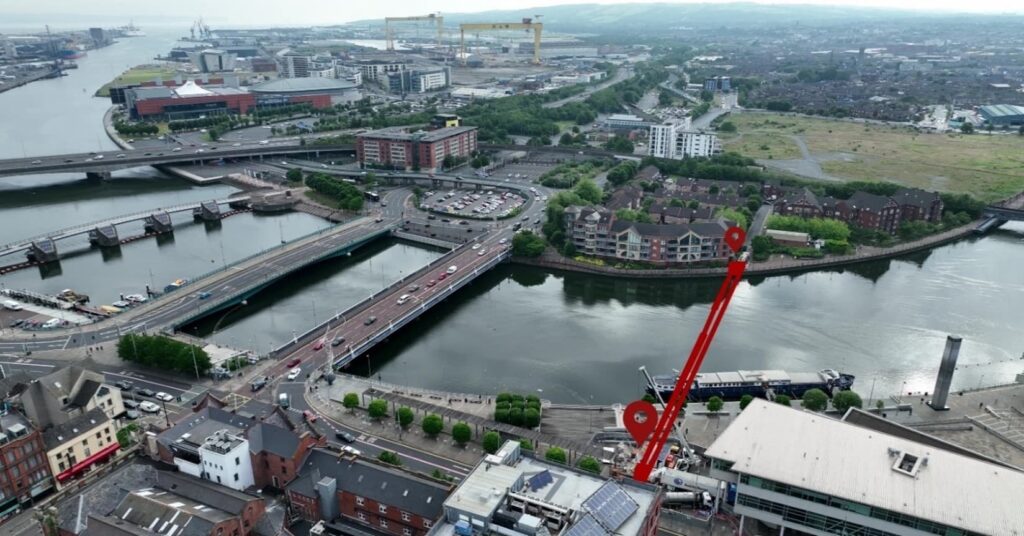
In 2015, DAWSON WAM were appointed by Northern Ireland Water (NIW) as part of an Early Contractor Involvement (ECI) to complete an appraisal of one of its most critical assets, twin sewerage siphons, known as the Queen’s Bridge Siphons, in Belfast Northern Ireland. The siphons’ transfer wastewater from a substantial proportion (circa 40,000 population) of the East of Belfast City under the River Lagan to the Oxford Street Trunk Sewer for onward transfer to the Belfast Wastewater Treatment Works.
The siphons, and their associated chambers, were constructed c1910 during the Titanic era. NIW shared copies of the siphons’ original construction drawings. From NI Water historical records, the Twin siphons were initially thought to be 1140mm (45”) dia. cast iron pipes 145m in length. Assessment of several options during ECI established refurbishment of the siphons would be split over Phase I & Phase II works.
Solution
Two chambers provide access to the siphon pipes, the locations of which are:
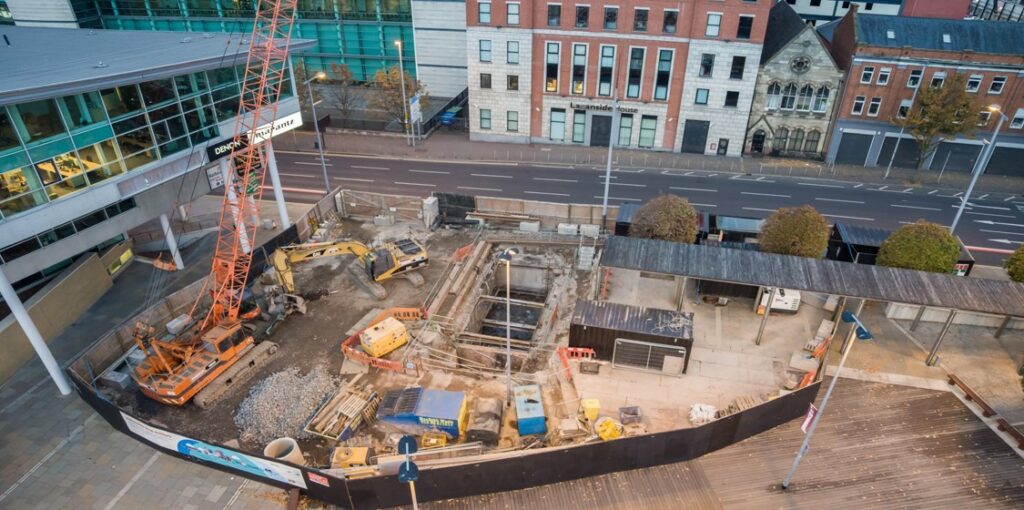
•On Greggs Quay, in a pedestrian area adjacent to a modern apartment development on the east riverbank.
•On Lanyon Quay, in a pedestrian area close to Belfast’s Waterfront Hall (a premier concert venue) on the west riverbank.
Penstocks within the chambers allowed closure of one, or both siphons for maintenance purposes. Wastewater flows enter the siphon system via the 9m deep Greggs Quay chamber where they descend vertically, flow through the siphon pipes under the river and then ascend vertically within the Lanyon Quay chamber and on to the Oxford Street chamber and trunk sewer.
Phase I works involved mainly civils construction comprising of cleaning/removal of debris from the siphons, construction of a new 9m deep access chamber at Lanyon Quay, refurbishment of the existing brick chamber at Greg’s Quay and installation/commissioning of four new manually operated penstocks. Phase I works were successfully completed by DAWSON WAM in 2019.
In January 2022, NI Water appointed MURPHY/DAWSON WAM JV as principal contractor to undertake Phase II works. This final phase of the project was to rehabilitate both siphons, by trenchless Cured-In-Place pipe Lining (CIPP) method, to prevent pipe failure and to extend their service life. The scope of works involved:
•Isolation and desilting of each siphon
•Preparation of pipe surfaces and removal of encrustations/surface imperfections by combination of remote robotic cutting and high-pressure jetting.
•Measurement of the siphons, including significant diameter changes by drone utilising Light Detection and Ranging (LiDAR) to produce a dimensionally accurate model of the siphons to ensure manufacture of the CIPP liner matched the pipeline including a transitional section in the North Siphon.
•Rehabilitation of each siphon by installation of CIPP liners by hot water cure method
•Commissioning and testing of CIPP liners.
•DAWSON WAM appointed Environmental Techniques (ET) as their specialist contractor to undertake the CIPP works. Options considered were UV Lining and CIPP Hot Cure Lining. After extensive review of the specific site conditions, CIPP Hot Cure Lining was chosen as the preferred solution from a technical and cost perspective.
In March 2022, works commenced on the extensive cleaning and removal of encrustation in the siphons in advance of the rehabilitation. By April 2022 the cleaning operation was substantially complete. Due to the significant diameter reduction in the mid-section for approximately 16m on the North Siphon, accurate measurements for the transitional CIPP section were paramount. The drone was deployed to not only monitor the encrustation removal completion but to also complete the LiDAR 3D model of the siphons with outputs.
The output model can be interrogated to determine dimensions, distances, displacements, size of obstructions, diameters of connections etc. The model can also be placed on topographic surveys to show the location of the sewer in relation to ground level features. The 3D scan can be geotagged, to show the exact geolocation of the pipe and exact geolocation of defects or points of interest. The measurements obtained from the drone were then used to produce a bespoke liner with transitional section with reduction in diameter from 1140mm to 870m for 15.9m then revert to 1140m for the remainder.
The composite felt liners consisting of needle felt carrier material impregnated with thermostatic polyester resin were manufactured by Insituform Linings Ltd (MTC) at their facilities in the UK and the Netherlands. Both manufacturing facilities are certified to the ISO 9001:2015 standard. There is control of every step of the manufacturing process and quality systems to ensure that the tubes are made to exact specifications. The manufacture was undertaken in 2 phases with the manufacture of the composite felt liners at Insituform’s UK facility and the resin impregnation of the liners at Insituform’s Netherland facility. The impregnated liners were transported to site in a refrigerated cooling container with temperature controlled and maintained prior to installation.
Result
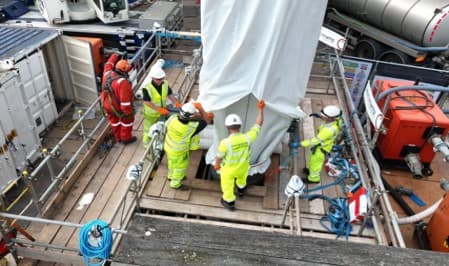
CIPP installation was completed over two weekends in June 2022 and involved the direct inversion of the CIPP lining tubes. Initially the CIPP tube was attached to a top ring turned inside out and with the use of a hydrostatic head of water inverted into the pipe. As the water is carefully introduced the resin-saturated tube is allowed to invert upon itself and progress longitudinally through the pipe in a continuous and controlled manner. Once inversion was complete the tube is cured by circulating heated water. During this process the temperature was monitored and recorded regularly at 15-to-30-minute intervals at the boiler inlet & outlet and at the thermocouples placed during inversion between the tube and the original pipe wall at the inversion and termination ends.
Once curing was complete cooling commenced by circulating cold (ambient) water through the hot water circulation hose with the lining remaining with the inversion head until the water temperature in the drop tube (monitored by a thermocouple wire placed in the drop tube) was at 40°C or below. Circulation of the water at this temperature continued for a period of at least 30 minutes.
After the system was cooled, the soft felt at the installation manhole was removed and the curing water pumped out and transferred into the downstream sewerage network. Liaison with NI Water took place to ensure there were no other works taking place on the immediate downstream trunk sewer that could be affected by this transfer of the curing water. Once the curing water was drained from the system a test sample was taken from the termination end and the end of the lining tube be cut open. The samples were sent to IKT Testing Facility in Germany. A final Survey Inspection was undertaken to provide documentation that the CIPP was properly installed. Both CIPP liners were installed successfully by a team drawn from Scotland, Northern Ireland, Isle of Man & Holland largely due to accurate measurement of the liners including transition sections to the Drone Survey & LiDAR 3D Modelling.
The Phase II rehabilitation works was successfully complete in August 2022 and the Siphon’s brought back into full service.