Campbeltown Flood Protection Scheme


Challenge
DAWSON WAM were awarded the £15m Campbeltown Flood Protection (FPS) by Argyll and Bute Council in June 2022 under an NEC3 Option A Contract. This £15.2m scheme which was 80% funded by the Scottish Government & 20% by Argyll and Bute council was delivered over an 18-month period under the Flood Risk Management (Scotland) Act 2009 where the council is responsible for developing sustainable flood management solutions. AECOM were employed by the council to provide design and project management support throughout the contract.
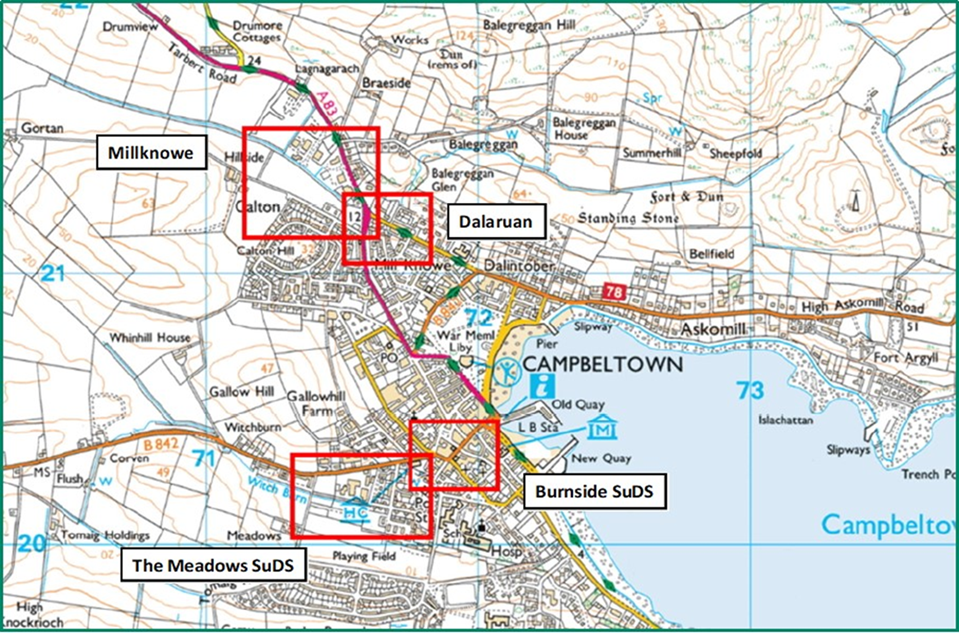
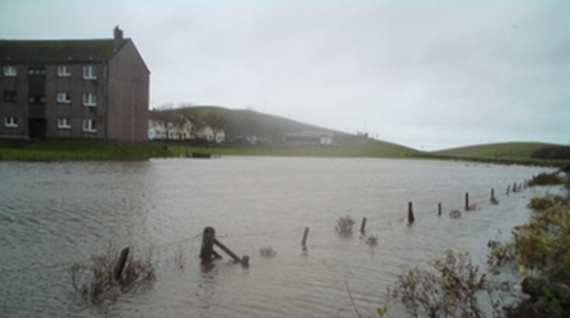
Campbeltown has experienced flooding over many years which has affected residential properties, businesses, roads, and community life in general. This came from several different sources. The existing sewer network system in the Burnside & Meadows areas could not cope with increasing amounts of surface water. The sewer network combined surface water with sewage water from households. When the system was overwhelmed during periods of heavy rain, fouled water backed up out of the system and flooded streets and premises. On the outskirts of the town is the Millknowe burn which due to several steep catchments is the most dominate flood source in Campbeltown. Flows from the Balgreggan Burn also caused overtopping during extreme events at the Dalaruan culvert intake and resulted in overland flows and flooding in the town.
Solution
The scope of the scheme was to reduce the risk of flooding from the Millknowe and Balgreggan Burns and from localised surface water in Campbeltown. This project was rolled out over four working areas:
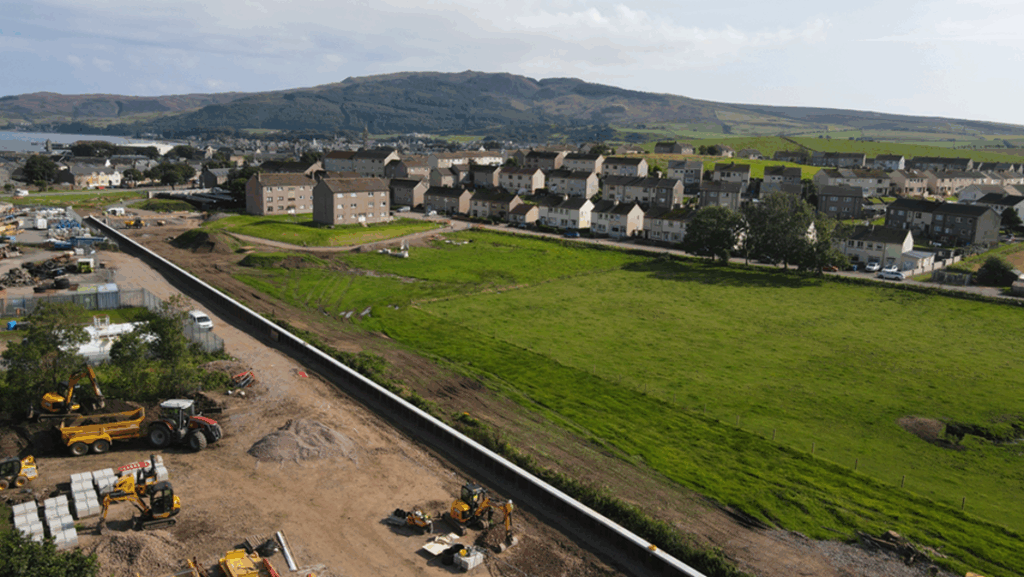
Millknowe Field is located beside the watercourse channel, it acts as a catchment area for rainwater, flooding onto nearby roads and streets, particularly the main A83 trunk road which provides the primary access into the town.
There are 2no. block of flats beside the field, built essentially on the same floodplain that are prone to flooding during heavy rainfall when the watercourse and culvert cannot cope with the flow of water.
Snipefield Industrial Estate is located on the northern side of the watercourse channel which is home to many local businesses was also prone to flooding from the field during heavy rainfall events.
The scope of works for the scheme included:
- Vegetation and general site clearance
- The construction of a flood storage reservoir in Millknowe field to provide temporary flood water storage within the watercourse channel during high rainfall events.
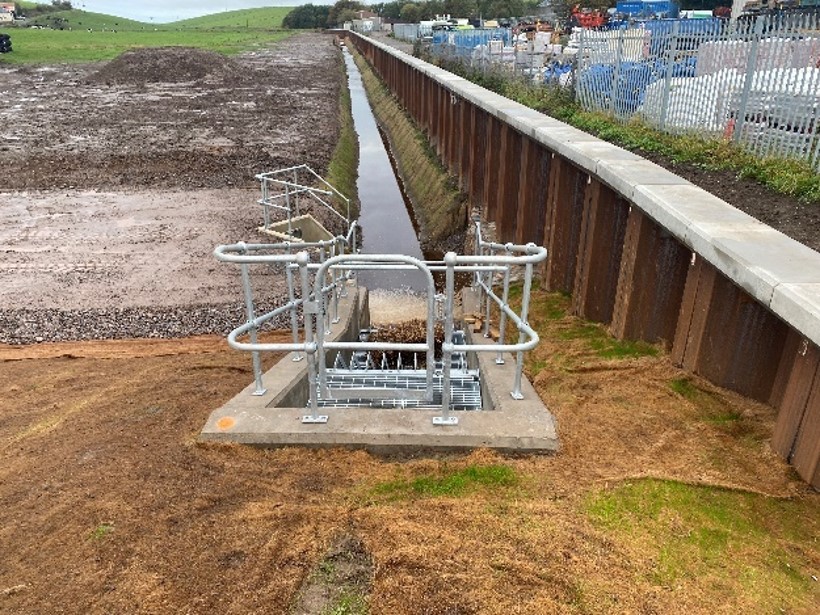
- Realignment of the watercourse channel along the new sheet piled wall.
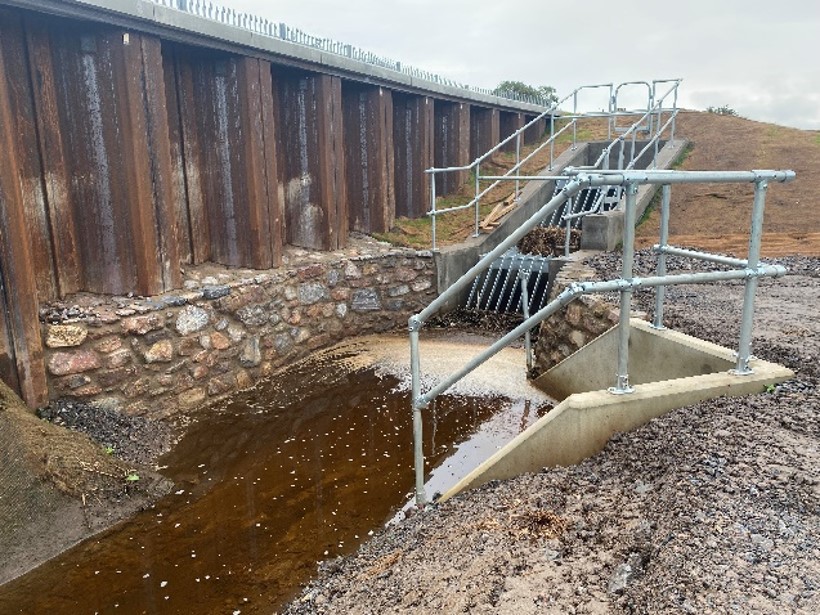
- Installation over 500m of new back of wall drainage ranging in diameter from 225mm to 600mm and new outfalls with flap valves through the new flood wall.
- Pre and post conditions surveys of adjacent buildings
- Landscaping reinstatement and the planting of trees and hedgerow.
The reservoir was constructed in line with the reservoir (Scotland) Act 2011 and consisted of a 125m long AZ19-700 sheet piled wall encased in a 2.6m average height earth embankment dam and concrete spillway, 325m of AZ20-700 sheet piled flood wall to form the enclosed dam structure and provide flood protection to Snipefield industrial estate. The sheet piles were driven into cohesive soils and ranged between 6m to 9.5m in length. A new concrete culvert passing through the dam with headwall and orifice plate was constructed to throttle the flows. The exposed piles were capped off with a pre-cast concrete coping.
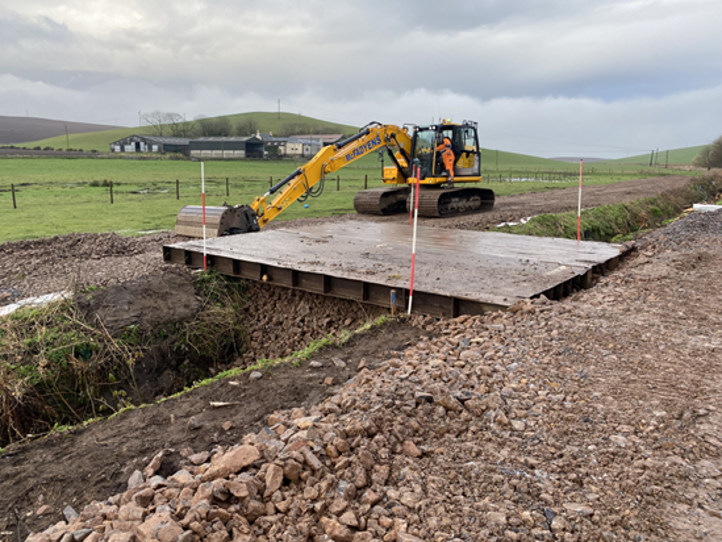
To facilitate the installation of the 450m of steel sheet pile wall, a 6m wide x 600mm deep stone temporary piling platform was installed to support our 90T ABI TM22 piling rig.To minimise the impact on the field, watercourse and to reduce the amount of imported stone required, where the space allowed the piling platform was constructed to the north of the watercourse, on the Snipefiled Industrial estate side minimising the length of the watercourse that required to be culverted.
DAWSON WAM’s in-house heavy-duty steel mats where also utilised which further reduced the amount of imported material for the piling platform. Three number temporary bridge culvert crossings were constructed using the mats which allowed full access along the length of the wall during construction. The sheet piles were purchased from Arcelor Mittal in Luxembourg, delivered, and held in our yard in Bedfordshire. The piles clutches were sealed using Biguma SV while in storage, paired and delivered to site in a just in time basis throughout the project.
The new sheet piled wall installation required to perpendicularly cross a 225mm asbestos cement Scottish watermain and a High Voltage (HV) Scottish Power cable. These two services were critical to the town infrastructure and any disruption or shutdowns would have caused a lot of disruption to the residents of the town. Traditionally these services would have to be diverted through the wall in a phased approach, resulting in inefficiencies and several shutdowns on the services.Through DAWSON WAM’s in house expertise and utilising its specialist vibrationless HydroPress piling equipment, installation of the piles was successfully able to be undertaken without diverting the services. This involved early liaison and working closely with the designer and utility providers, undertaking trial pits to ascertain the ground conditions, installation of vibration monitors onto the services to highlight vibration levels during install and agreeing a short shut down of the services during pile install adjacent to the services.
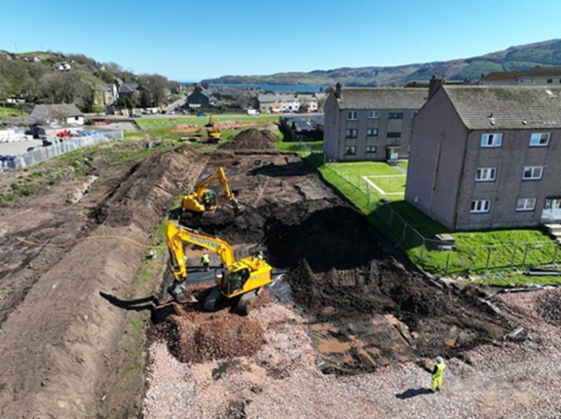
The earth embankment at Millknowe consisted of a upto 4m high 125m long embankment with a 21m in-situ reinforced concrete spillway. The embankment footprint was excavated removing 3000t of topsoil, 6000T of peat and associated soft soils to form the earth embankment foundation on alluvial or raised beach deposits with a Cu value greater than 40Kpa. To consolidate the formation level prior to construction trial pits were excavated along the footprint of the structure and with the aid of a shear vein test the Reservoir Construction Engineer (appointed by the employer) witnessed and approved the formation levels on site.
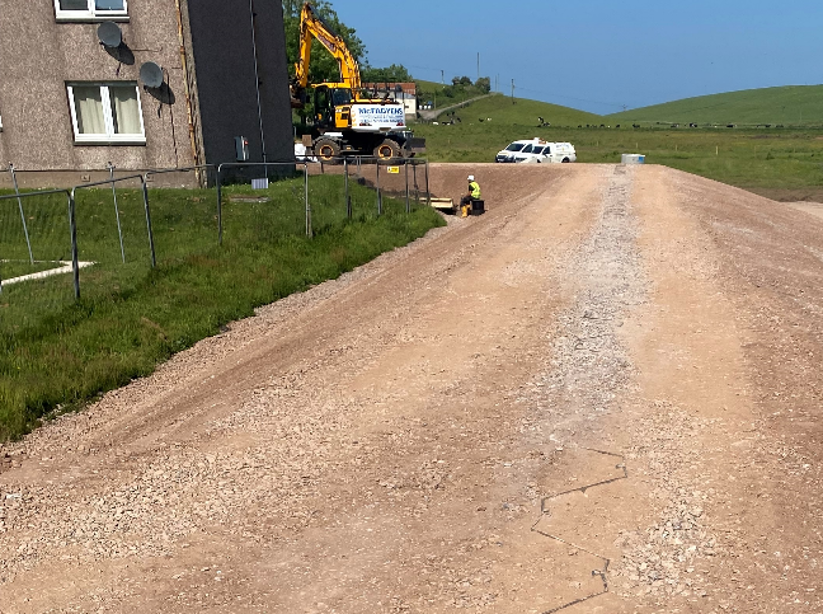
2,600t of locally sourced Class 6C compacted in accordance with CESWI 7th Edition in a 500mm deep layer formed the foundation of the embankment. The main body of the embankment was constructed using 5,800t of compacted Class 1A granular fill, with the maximum embankment height of 4m with sloped of 1V:3H. Class 6N granular material was used to segregate the Class 6C and Class 1A material around the piles. The embankment was capped with a 300mm layer of site won screened topsoil and reinforced with coir matting and seeded with a wet meadows mix. Associate embankment toe drainage and a hardstand access road was provided for future maintenance access.
As part of the works 3no. detention basins to temporarily attenuate surface water runoff before releasing it back into the existing Witchburn Culvert system.Over 3km of new storm pipework ranging from 150mm to 900mm were installed across the scheme to separate storm water from the existing combined network to connected to and from the various new flood storage structures.
Online replacement of 285m of the existing culvert on Dalaruan Street, from the Millknowe flood storage area with 285m of twin & single culvert ranging in size from 675mm dia. to 900mm dia. This upgrade generated increased capacity to store and convey flood flows more efficiently during flood events and to cater for flooding at Balgreggan Burn.
Result
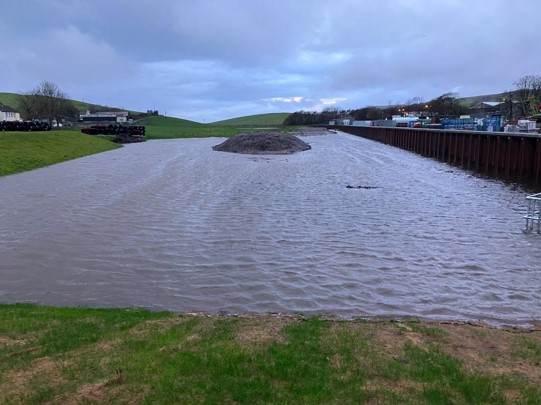
Post-Construction, in two separate flooding events in Autum 2023, and before the overall project construction completion, the reservoir at Millknowe was called into action during two periods of heavy rainfall where the reservoir filled up.
The Milknowe Service Reservoir has already protected the town from flooding and will continue to protect in years to come.
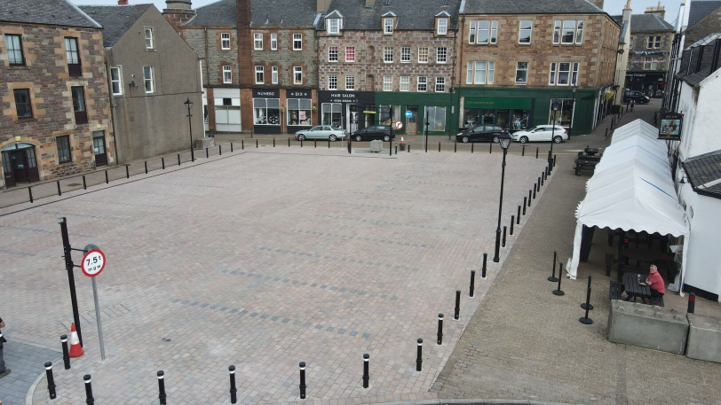
Burnside Square is at the heart of Campbeltown and tp temporarily store and attenuate 542 m3 of surface water runoff a new underground geocellular attenuation tank was to be installed as well as newly constructed storm separation pipework during high rainfall events before releasing it back into the existing culvert network.
To provide the temporary works our inhouse secant piled solution provided a robust cofferdam to accommodate the buildability of the tank and maintain pedestrian access to the premises around the square during construction. Upon completion the square was fully reinstated and returned for public amenities.
Community Benefits
It was obvious from inception that, engineering challenges apart, one of the key challenges for the project team would be constructing the works within this rural town in Scotland who would not have previously witnessed a construction project on this scale. Effective consultation with stakeholders, which included road users, local businesses, residents, the general public and affected landowners, would be key to the minimising disruption and to the project’s successful delivery.
Several pre-construction pop up events were held with the residents, businesses, stakeholders, and the public. Consultations were carried out through Argyll and Bute’s internal communications team and monthly newsletters were issued through the portal giving updates on construction progress and programme of works and queries were managed through the site-specific e-mail and emergency contact number. Public drop-in meetings and letter drops were undertaking in advance of entering a new area of works.
A project of this size and complexity will always have as significant local impact and it was important that the project team endeavoured to engage with and, for the duration of the project, be part of the community. Initiatives to promote community engagement included: visits from the construction engineering team to Dalintober and Drumlemble primary school, education the children on the dangers of construction sites, donations of PPE waterproof to the school to help support their learning and exploration group. Donation of a ‘LEGO EDUCATION SPIKE PRIME Set’ to help engage STEAM learning and problem-solving skills. Donation of Ukuleles to the local kids’ music group. Local charity donations including a £5,000 donation to the Kintyre Sea sports charity to purchase new equipment to aid in the training and development of the local disadvantaged children in water activities. Voluntary repairs to the Campbeltown youth football team goal posts and changing facilities access paving prior to a kid’s football tournament. Donation of 6T of topsoil to Campbeltown Climate Action for use in their community garden. Supply and installation of a bicycle rack in Burnside Square.
The most significant community benefit was the employment of a local sub-contractor to undertake the majority of the construction works, this provided and supported employment to the residents of Campbeltown and supported the local businesses as the money stayed in the community.
Client
Argyll & Bute Council
Design Engineer
AECOM
Main Contractor
Dawson-WAM